

 Menu
Search
Menu
Search
€4.15
Regular price:
€4.39
€30.98
Regular price:
€35.85
€17.56
Regular price:
€22.44

€44.39
Regular price:
€49.27
€44.39
Regular price:
€49.27

€24.15
Regular price:
€29.02
€24.15
Regular price:
€29.02
€25.85
Regular price:
€30.73
€40.73
Regular price:
€45.61
€57.80
Regular price:
€62.68
€37.32
Regular price:
€42.20

€29.02
Regular price:
€31.46


€88.78
Regular price:
€93.66
Login
Languages

 Browsing options
Price
-
from
to
Australian Ant Colonies for Ant Keeping
Ants from Australia include fascinating exotic species known for their high activity levels, complex social behaviour and care requirements that differ from those of commonly kept European ants. In the wild, they inhabit warm and diverse ecosystems, which translates into specific temperature, humidity and colony setup requirements in captivity.
At AntCenter, you can find carefully selected Australian ant colonies recommended primarily for experienced ant keepers. We offer responsibly sourced species together with suitable ant-keeping equipment, helping you create stable conditions for the colony’s development, feeding and observation.
What Makes Australian Ants So Distinctive?
Australian ants attract experienced ant keepers with their intense activity, unusual movement and complex social behaviour. Depending on the species, they may live in trees, create elaborate nest structures or display exceptionally fast and dynamic worker activity.
Keeping these ants requires carefully prepared conditions. Temperature, humidity, ventilation, feeding and escape prevention must be matched to the biology of the particular species. There is no single colony setup suitable for every Australian ant species.
Which Australian Ant Species Can You Find at AntCenter?
Our selection may change seasonally and depends on colony availability. Species featured in this category include:
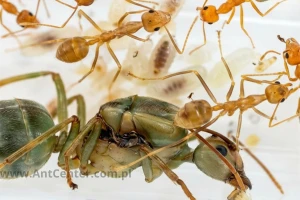
Oecophylla smaragdina – Australian Weaver Ants
Oecophylla smaragdina is an active and territorial arboreal species. In the wild, workers use silk produced by their larvae to join leaves and construct nests. In captivity, the colony requires climbing space, suitable ventilation and carefully planned escape prevention.
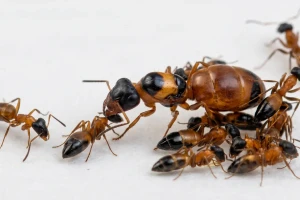
Opisthopsis rufithorax – Fast-Moving Australian Ants
Opisthopsis rufithorax is known for the workers’ remarkably fast and distinctive movement. We recommend keeping a small colony in its test tube setup, where stable conditions are easier to maintain and colony development can be monitored. Additional space should be introduced gradually as the worker population increases.
Who Should Keep Australian Ant Species?
Australian species are generally recommended for ant keepers who already have experience caring for a colony and controlling conditions inside a formicarium. Their high activity levels, temperature requirements and need for reliable escape prevention mean that they are not usually the best choice for a first ant colony.
Before selecting a colony, consider:
- the colony’s expected size and growth rate,
- its temperature and humidity requirements,
- the natural nesting behaviour of the species,
- its feeding requirements at different stages of development,
- the most suitable method of escape prevention.
How Should You Prepare a Formicarium for Australian Ants?
The colony setup should be selected according to the biology of the species and the colony’s current size, rather than its geographical origin alone. A young colony may initially develop in a test tube setup, while arboreal species may later require vertical space for climbing and building their own nest structures.
Before introducing the colony, check all connections, ventilation openings and access points used for feeding or cleaning. Fast and highly active species require a reliable escape barrier and a carefully planned maintenance routine.
FAQ About Australian Ants
Are Australian ants suitable for beginners?
Most Australian species available in specialist ant keeping are better suited to experienced keepers. They may require additional heating, reliable escape prevention and close monitoring of environmental conditions.
Do Australian ants require winter diapause?
Seasonal requirements depend on the particular species and its region of origin. Tropical and subtropical ants should not automatically be given the same winter diapause as many Central European species. Always follow the care guidance provided for the selected species.
What type of formicarium should I choose for Australian ants?
The formicarium should match the biology of the species and the size of the colony. Small colonies may initially remain in a test tube setup, while arboreal ants such as Oecophylla smaragdina require space for climbing and nest construction.
What do Australian ants eat?
Feeding requirements vary between species, but many active colonies need both a source of carbohydrates and suitable protein food. The type and frequency of feeding should be adjusted to the colony colony’s size, the amount of brood and the care guidance provided for the particular species.
How can I prevent Australian ants from escaping?
The outworld should be secure, properly ventilated and protected with an escape barrier suitable for the species, such as Fluon. With exceptionally fast ants, feeding and cleaning should be planned before the outworld is opened.
What Should You Do Next?
Compare the available Australian ant colonies and review the care requirements provided on each species page. If you are unsure whether you can provide suitable conditions, contact AntCenter before ordering — we will help you select an appropriate colony and ant-keeping setup.