










Modular Ant Farms – A Practical Guide Based on Real Experience
Over the years of keeping and observing ants, I have learnt one thing with absolute certainty: a colony never grows exactly the way you expect it to. One week they expand brood chambers, the next they fill every corner with seeds, and suddenly your carefully planned setup is far too small. This is where a modular ant farm becomes more than a convenience — it becomes a tool that grows alongside your colony, safely and naturally.
In this guide, I’d like to share my practical experience from testing dozens of layouts, materials and ventilation systems while developing AntCenter’s BlackAnt and AntLove modular lines. These insights come from real colonies, not theory.
Why Modular Systems Work Better in Practice
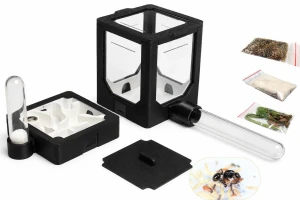
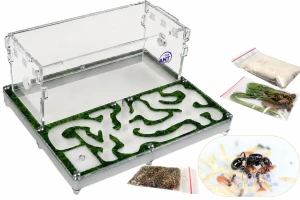
A modular ant farm is built from separate units — nests, outworlds, connectors and tunnels — that can be combined and rearranged as the colony grows. You begin with the basics, then expand step by step without forcing the colony to move or breaking the environment that they have already stabilised.
What many keepers don’t realise is that every AntCenter formicarium, even older non-modular models, has at least one tubing port. This means all AntCenter units can be linked into a modular structure. The newer BlackAnt and AntLove systems simply take this idea further with more ports, better airflow and improved durability.
What Makes BlackAnt and AntLove Practical for Daily Use?
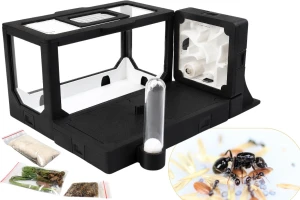
After years of testing different materials, I found that the combination of 3D-printed chambers with transparent plexiglass offers the best balance between durability, visibility and humidity control. That’s why every BlackAnt module is built this way.
Each module has 1 to 3 ports per side — a minimum of four and up to twelve in the largest units. The BlackAnt XXL Outworld with 12 connection ports gives keepers the freedom to create extremely flexible layouts. In my own colonies, this module consistently produced the calmest traffic flow and the lowest stress levels during expansion.
BlackAnt and AntLove also use micro-ventilation: dozens of tiny holes that provide airflow without risking escapes. For species like Messor or Lasius, this stability is crucial.
How Colonies React to Modular Expansion (from Real Observations)
From practical experience, ants behave differently depending on how you expand their environment. When you add a new module to an already stabilised setup, you’re giving the colony a choice: explore, move brood, open new foraging paths.
In almost every test I ran, ants showed more natural behaviour when the expansion was gradual. For example:
- Adding a side module reduced stress compared to replacing the whole nest.
- Connecting a second outworld lowered crowding during feeding hours.
- Providing two entrance options changed how ants organised traffic, often improving efficiency.
These are subtle differences, but in ant keeping, subtle differences usually grow into big ones as the colony expands.
Which Modules Do I Recommend for Beginners?
Many beginners think they need a large setup immediately, but I’ve never seen this benefit a young colony. Instead, I recommend starting with:
- a small or medium nest module,
- a single outworld with good ventilation,
- a connector or a short piece of tubing,
- basic feeding and watering equipment.
As soon as you notice brood piling up, workers clustering in corners or increased foraging traffic, it’s time to add the next module. With a modular system, this is a matter of seconds — and, importantly, without any forced relocations.
Ventilation, Humidity and Cleaning — Practical Insights
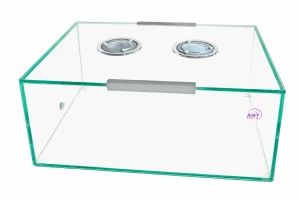
I’ve seen many setups fail due to poor ventilation. Too little airflow leads to mould, too much dries out the brood chambers. This is why BlackAnt outworlds and nests use micro-ventilation and, in some models, an optional ventilation cap for fine adjustment.
Another advantage of modular systems is maintenance. With traditional one-piece formicaria, a single mould spot often meant dismantling half the environment. In contrast, modular units can be removed, cleaned or replaced individually — a far safer process for the colony.
Common Mistakes I See New Keepers Make
- Expanding too quickly: Too much empty space confuses young colonies and slows down brood development.
- Mixing incompatible brands: Even slight differences in port diameter can cause leaks or unsafe connections. AntCenter modules are designed to match within one system.
- Overlooking airflow: Good ventilation is far more important than most beginners think. It directly affects humidity, mould risk and overall colony stability.
What Next?
If you’re planning your first modular expansion, take a look at our English guides:
As your colony grows, simply add the next module — and build your ant farm like a living, evolving structure, piece by piece.
Frequently Asked Questions about Modular Ant Farms (FAQ)
Are all AntCenter formicaria modular?
Yes. Every AntCenter nest and outworld, including older models, has tubing ports, allowing you to connect and expand your setup in a modular way.
How many ports do BlackAnt and AntLove modules have?
Depending on the module, there are between 4 and 12 ports in total. Most modules include 1–3 ports per side, giving flexibility in layout design.
When should I expand my modular ant farm?
Increase space when you notice crowding, brood clusters or heavy foraging traffic. Expanding gradually helps the colony adapt more naturally.
Is a modular setup better for beginners?
Yes. Modular systems let beginners start small and expand safely without moving the entire colony to a new formicarium.
Why is ventilation so important?
Proper airflow helps prevent mould, keeps humidity stable and creates a safer, more controlled environment for brood development.